Offshore reef, Santa Teresa Gallura
Corallo Nero
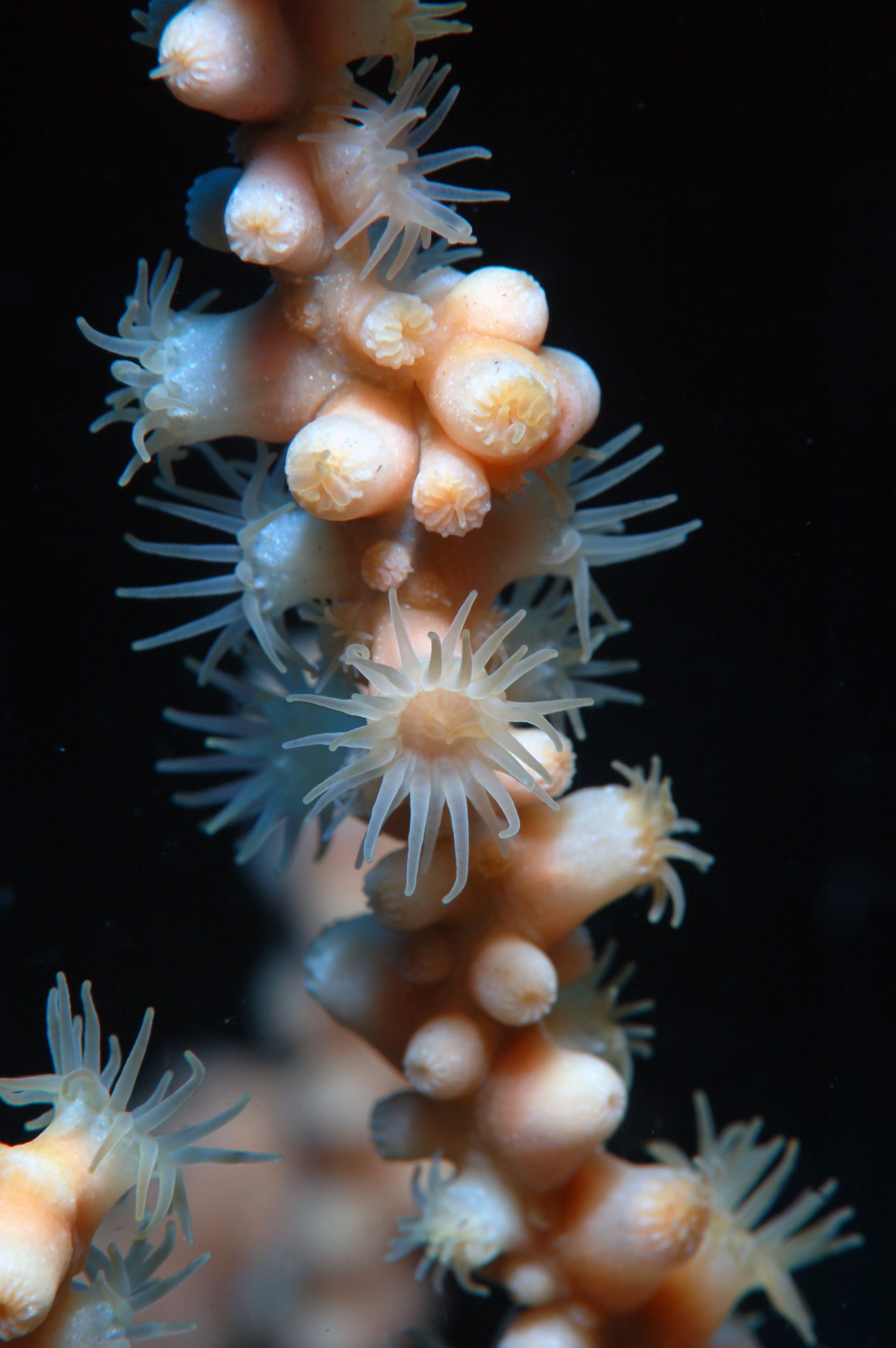
A colonial animal with a golden crown and a skeleton like horn, on a reef in the dark.
- Depth
- 25–40 m depending on itinerary
- Certification
- Deep
- Experience
- Advanced
- Current
- Moderate
- Dive Style
- Coralligenous Reef · Offshore Reef
How we rate
Our ratings compare the twenty-eight dives in this Explorer with one another; they are not universal scores. They show where each site stands within the DCC selection for photography, scenery and marine life, and five represents the strongest expression of that quality.
The Dive
The traditional name of this site is misleading and the site is better for knowing why.
Savalia savaglia — long known as Gerardia savaglia, and still called that locally — is not a black coral. It belongs to the order Zoantharia, and its resemblance to the tropical black corals is convergence, not kinship: it builds a horny, non-calcareous skeleton of chitin and protein, laid down in concentric layers, while the living tissue is a distinctive yellow-gold. It begins life as a parasite on gorgonians, overgrowing its host and eventually extending onto bare rock. It grows extremely slowly, and a Mediterranean specimen radiocarbon-dated in 2025 returned an age of roughly eight hundred years — the accumulated structure of many coalesced colonies rather than one animal, but a useful measure of the timescale involved.
This reef holds a notable colony of it. That, and not the fish, is the reason to dive here: a granite rise on a deep bottom, a metre-and-a-half fan of an animal that grows by centimetres a decade, and the coralligenous community around it.
Also known as Falso Corallo Nero · Gerardia (IT, traditional)
The Experience
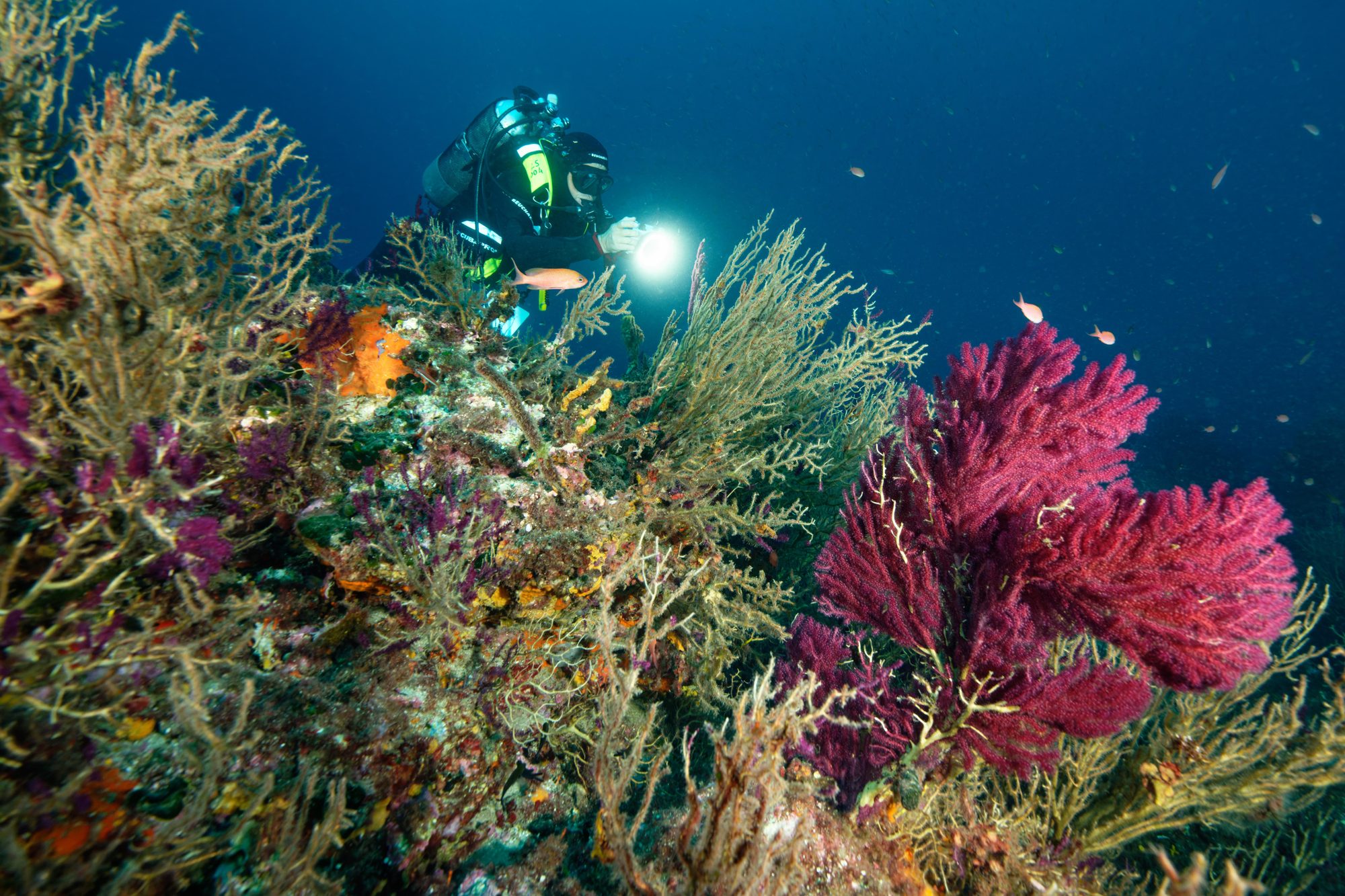
The descent is into progressively colder, flatter light. By thirty metres the warm end of the spectrum has gone and the reef looks uniformly blue-grey — which is exactly why the site demands a torch and why turning one on is a small event. The colour comes back all at once: gold, red, orange, yellow.
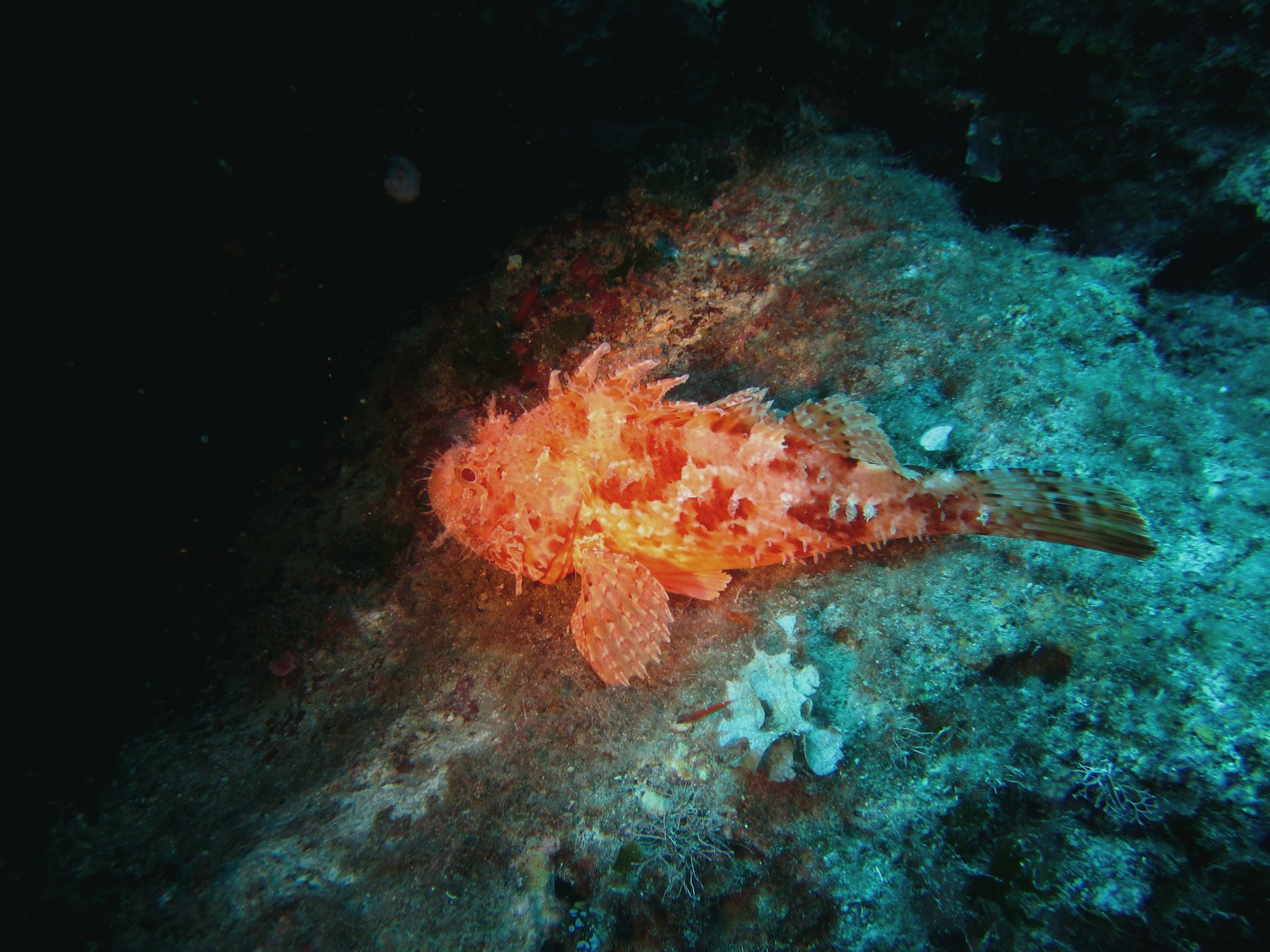
The colony itself appears as a branched fan standing off the rock, and it holds the dive's attention completely. Around it the reef carries the usual population of a deep Mediterranean hard bottom, cryptic and slow — grouper in the larger recesses, scorpionfish that do not move, lobster antennae in the cracks.
Underwater Landscape
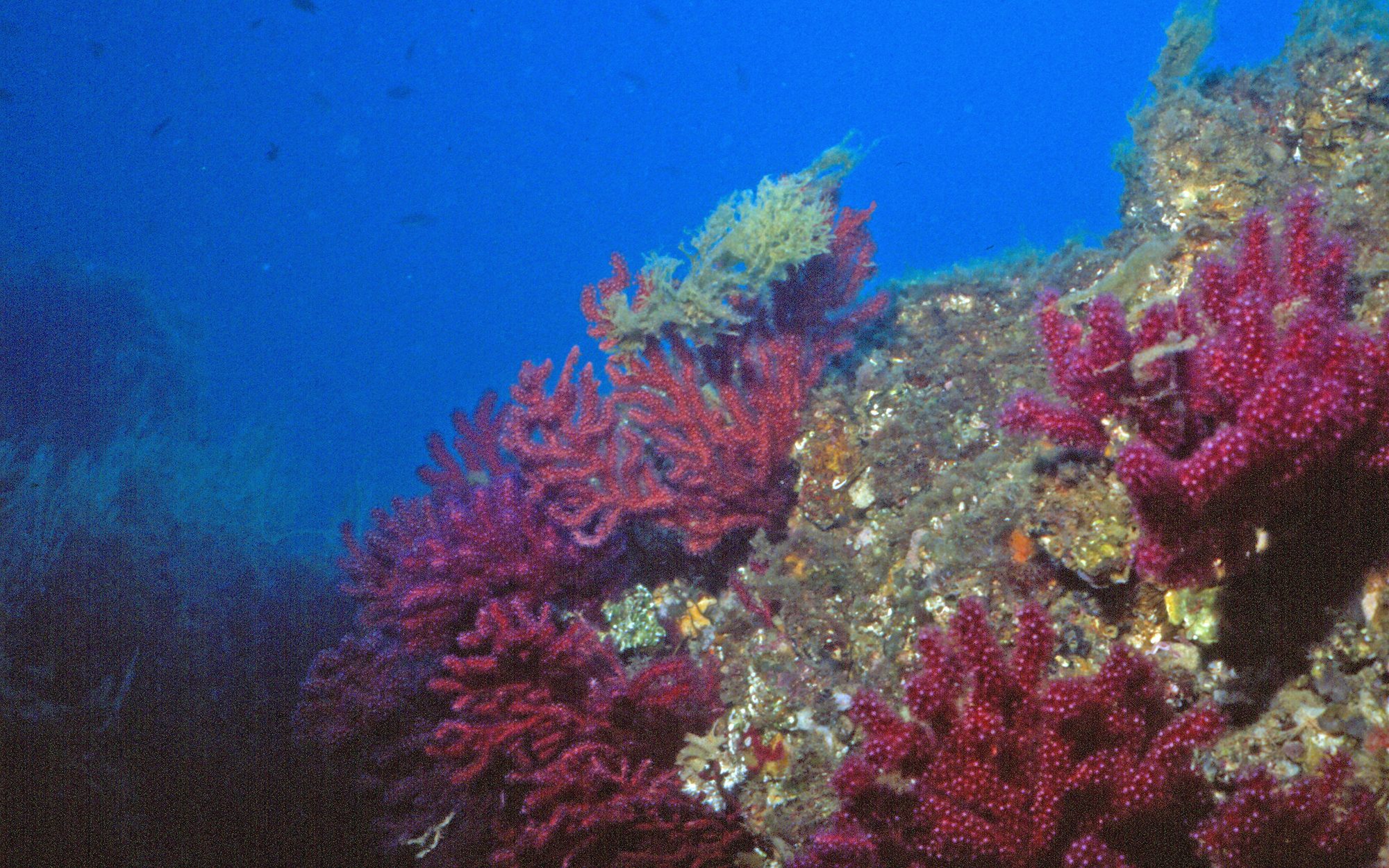
An isolated granite rise standing some ten to twenty metres off a deep bottom, colonised by coralligenous communities. Hard substrate, shaded faces, low ambient light.
Why It’s Special
- 01
A documented colony of *Savalia savaglia*, a protected and exceptionally long-lived species
- 02
A deep coralligenous environment, completely unlike the bright granite of the shallower sites
- 03
The moment artificial light first hits the reef, which is genuinely a highlight
- 04
A dive where the subject is a benthic organism rather than a fish
- 05
Serious buoyancy practice with an obvious reason for it
Marine Life
The deep-reef community: dusky grouper, moray, scorpionfish, spiny lobster and seabream among the rock. Nudibranchs and small benthic invertebrates on the colonised surfaces reward close attention.
Flora & Benthic Life
Savalia savaglia, the false black coral, is the site's defining organism — a zoantharian, protected under the Barcelona and Bern Conventions and assessed as Near Threatened on the IUCN Red List. The surrounding coralligenous framework is built by encrusting calcareous red algae over centuries, with sponges, bryozoans and gorgonians growing on it. White gorgonian occurs on the shallower rock in this sector.
Best Conditions
An offshore reef requiring settled conditions and a coherent plan for depth, gas and group. Moderate current is usual. The dive is short by nature and is not extended to compensate for poor visibility.
Photography
A lighting dive. Nothing here works on ambient light, and the honest constraint is that you have a short working window at depth. Close-focus wide angle on the Savalia fan — lit from the side, never flat-on — is the defining image. Macro on the coralligenous surfaces is the productive alternative if the colony is crowded.
DCC Tip
Light the colony from one side and let the other side stay dark. Divers instinctively floodlight it, which flattens the structure into a yellow smear; raking light from an angle is what shows you the branching and the texture of the skeleton.
Safety & Conservation
A deep dive on an offshore reef, planned with a fixed maximum depth, a conservative gas reserve and a defined bottom time; certification and recent deep experience are verified before it is offered. Savalia savaglia is a protected species and the colony is centuries old — no contact of any kind, including with fins, gauges and hoses, and no attempt to position a camera against the rock. Nothing is taken. Access is subject to current protected-area regulations and daily operational conditions.
Collections