Spargi
Secca Washington
The best dive in the archipelago, on the days it lets you.
- Depth
- 6–40 m depending on itinerary
- Certification
- Advanced
- Experience
- Advanced
- Current
- Potentially Strong
- Dive Style
- Pinnacle / Shoal · Coralligenous Reef · Wall
How we rate
Our ratings compare the twenty-eight dives in this Explorer with one another; they are not universal scores. They show where each site stands within the DCC selection for photography, scenery and marine life, and five represents the strongest expression of that quality.
The Dive
Secca Washington is a granite seamount off Spargi that rises out of deep water to within a few metres of the surface, and it is the most complete dive in this catalogue. It has the vertical range, the current, the gorgonians and the fish, and it has them all at once.
The name is a local curiosity. Two independent sources attribute it to a boulder whose profile is said to resemble the American president; there is no wreck called Washington here, and the well-known wreck of that name is in Liguria, at Portofino. The etymology is unsettled and the page says only what is defensible.
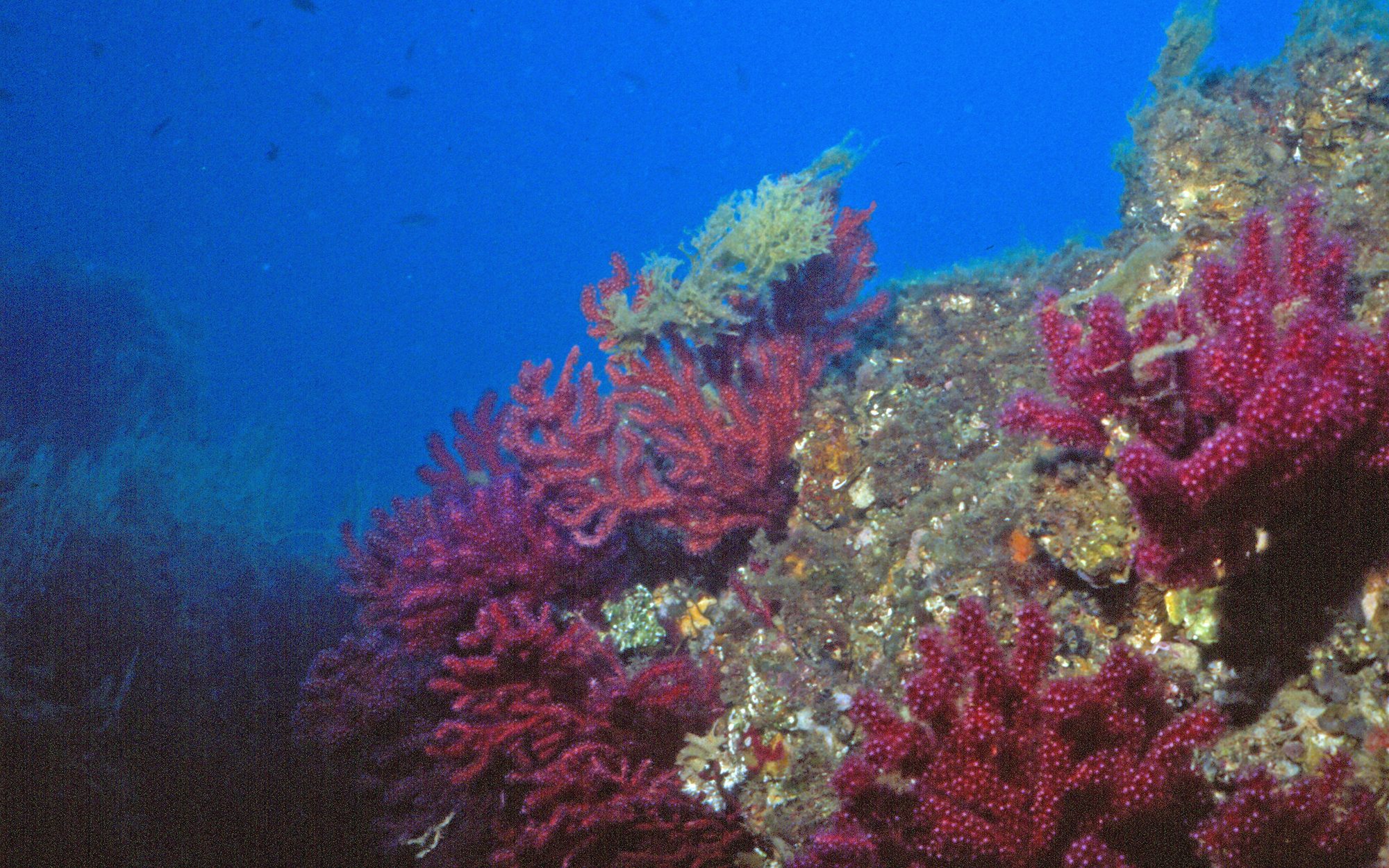
What is not in doubt is the structure. The seamount is a set of granite formations aligned in a long axis, with passages, caves and tunnels between them, near-vertical walls on the western side and gentler ground to the east. Red gorgonians appear from around fifteen metres, fed by the current that runs across the shoal from the north-west and north-east, and the walls beneath them carry dense yellow zoanthid cover.
Also known as Secca di Spargi (IT, park designation) · Washington Rock · Secca del Washington
The Experience
The shoal appears beneath the boat like a submerged hill, and the dive starts high and works down one flank. The western walls are the dramatic side: steep, shaded, and carpeted in gorgonians and zoanthids, with the fish stacked against them.
There is a lot happening at once. Grouper — large and numerous — hold along the rock. Brown meagre and dentex are routine. Barracuda school in the water column, and amberjack and, occasionally, tuna pass on the exposed side; eagle rays are reported with increasing frequency over the shallower eastern ground. The ascent up the eastern flank into bright water is the natural end of the dive, and it is unhurried.
Underwater Landscape
A granite seamount: aligned monolithic formations with long passages, caves and tunnels between them; near-vertical walls on the western aspect and gentler sloping ground to the east; a cap in the upper single figures over a deep surrounding bottom.
Why It’s Special
- 01
A true offshore seamount, from a deep base to a cap within metres of the surface
- 02
Dense red gorgonian growth from around fifteen metres on the current-exposed walls
- 03
The highest concentration of large fish in this catalogue
- 04
Granite passages, caves and tunnels within the seamount structure
- 05
Increasingly frequent eagle ray reports on the shallower ground
Marine Life
Dusky grouper, large and numerous along the rock. Brown meagre, common dentex, moray, spiny lobster and conger. Barracuda in the water column; amberjack and occasionally tuna on the exposed side; eagle rays reported over the shallower eastern ground. Dense shoals of damselfish, anthias and anchovy over the structure.
Flora & Benthic Life
Red gorgonian (Paramuricea clavata) from around fifteen metres, strongest on the current-exposed faces. White and yellow gorgonians are also reported. The western walls carry dense yellow cluster anemone cover, over a coralligenous framework of encrusting calcareous algae, sponges and bryozoans.
Best Conditions
Current is constant here and can be strong; it comes principally from the north-west and north-east quadrants, and it is what feeds the gorgonians. The entry point and the direction of the circuit are decided from the boat on the day. Settled conditions and good visibility are what turn a good dive here into a memorable one, and the site is postponed rather than compromised.
Photography
The five-star site of the catalogue and the only one that earns five across all three scales. The definitive frame is the western wall: gorgonian fans in the foreground, a diver mid-frame, and open blue behind, shot slightly upward with the strobes pulled wide to avoid backscatter in moving water. Fish shoals over the cap are the secondary subject, and there is enough of both that you should plan for one and accept the other as a bonus.
DCC Tip
Find the depth where the gorgonians, the light and the fish overlap — usually somewhere in the twenties — and spend most of the dive there rather than going to the bottom because the bottom exists. Washington rewards the diver who chooses one band and works it.
Safety & Conservation
An exposed offshore seamount with significant current: surface marker buoys are carried, the group stays together, and the circuit is planned to use the flow rather than fight it. Depth is fixed before entry; the site's vertical range makes creeping descent the principal risk. Red gorgonians are slow-growing, heat-stressed habitat-forming species — Mediterranean populations have suffered repeated mass mortality events during marine heatwaves — and they break on contact: no handholds, no fin contact, no pressing a camera against the wall. Diving here is subject to national park authorisation, current protected-area regulations and daily operational conditions.
Collections
Dive these too
La Maddalena Archipelago
Picchi di Coticcio
Pink granite spires rising almost to the surface, in still water.
La Maddalena Archipelago
Spargiottello
Two gorgonian species zoned by light, and barracuda on the cap.
La Maddalena Archipelago
Secca dei Monaci
An exposed offshore shoal where the hunting is the event.