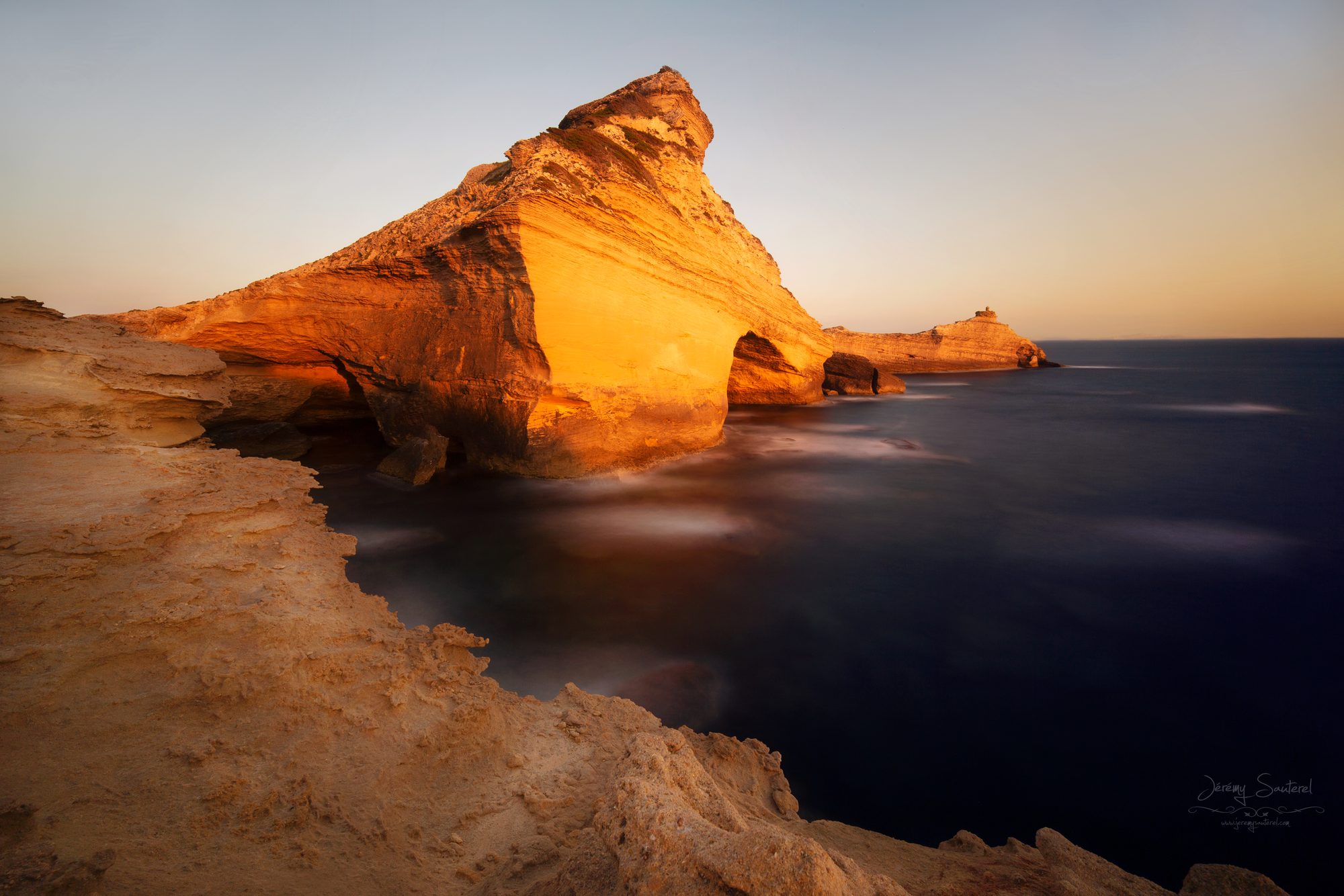
Bonifacio — cliff foot
Cap de Pertusato
The only dive in this catalogue that is not on granite.
- Depth
- 2–12 m
- Certification
- Open Water
- Experience
- Beginner
- Current
- Condition-dependent
- Dive Style
- Shallow Reef · Wall
How we rate
Our ratings compare the twenty-eight dives in this Explorer with one another; they are not universal scores. They show where each site stands within the DCC selection for photography, scenery and marine life, and five represents the strongest expression of that quality.
The Dive
Everything else here is granite. Pertusato is limestone, and the difference is immediate.
Bonifacio stands on a Miocene carbonate platform — a pale, layered sedimentary rock laid down in a shallow sea — and the vertical white cliffs the town is famous for are the sea's edit of it. Below the waterline the same rock continues, undercut and fissured, and it behaves quite differently from granite underwater. Limestone returns light instead of absorbing it. The water beneath the cliffs reads turquoise rather than deep blue, the bottom is pale, and at two to twelve metres the whole dive takes place in an unusually bright, open space.
This is not a site for depth or for large fish. It is a site for the geological contrast, for very easy first dives, and — practically speaking — for the days when the Strait is running and the offshore shoals are out of the question. The cliff foot is often flat when nothing else is.
Also known as Pertusato · Capo Pertusato (IT)
The Experience
The dive begins in water shallow enough to stand up in and works along the base of the cliff, following ledges and undercuts in the pale rock. There is no depth to manage and no navigation to speak of.
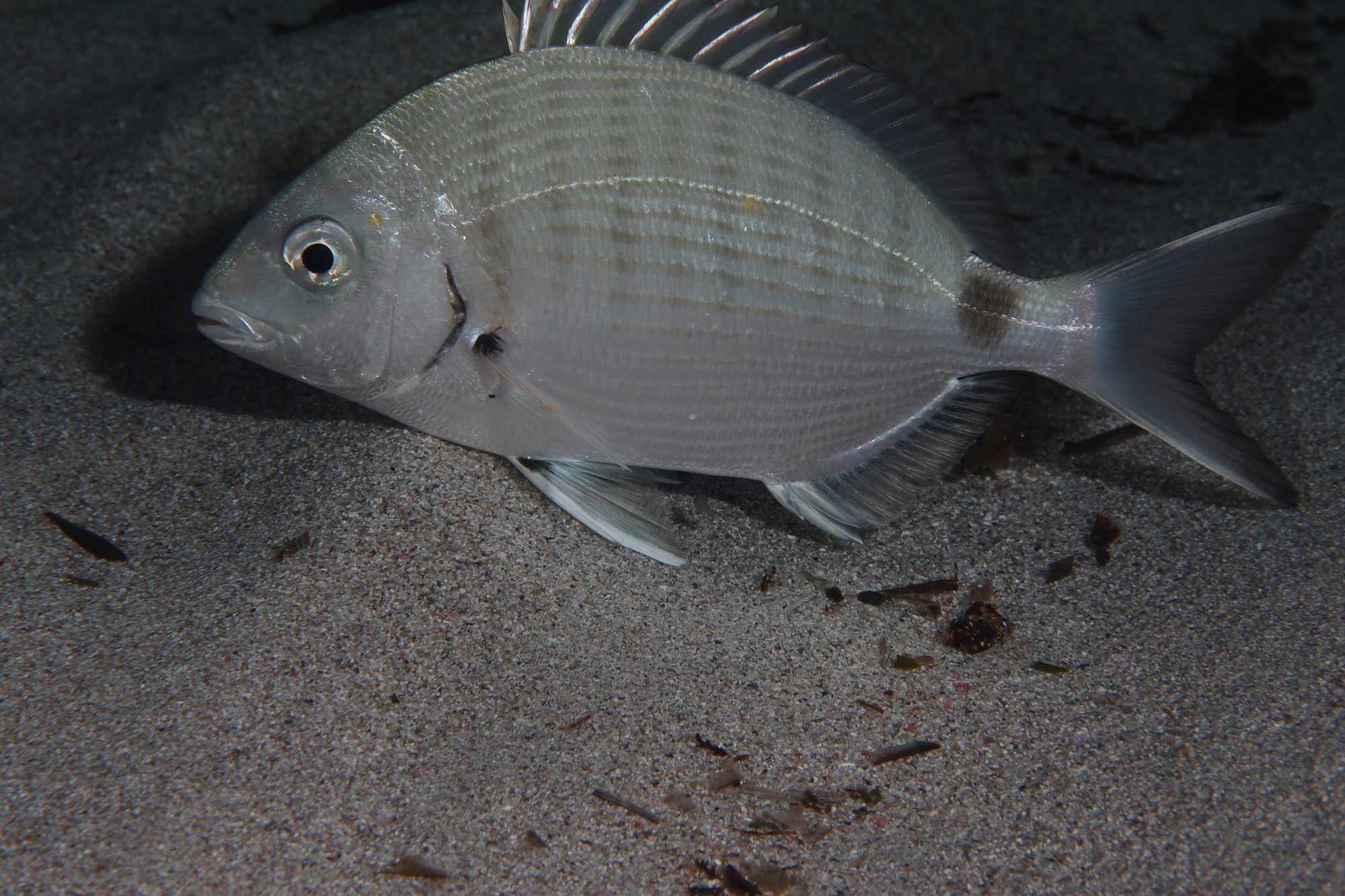
The interest is at close range: small reef fish over the ledges, salema grazing in loose shoals, nudibranchs on the shaded undersides, and the sculptural quality of the rock itself, which is bedded and eroded in a way granite never is. Looking up, the cliffs continue out of the water for another sixty metres, which is a view divers rarely get.
Underwater Landscape
Miocene limestone: bedded, pale rock with ledges, undercuts and fissures at the cliff foot, over a light-coloured bottom. Shallow throughout, with the cliff face continuing above water.
Why It’s Special
- 01
Limestone, not granite — a complete geological change within a short boat run of the Lavezzi
- 02
Exceptionally bright, shallow water at the foot of Bonifacio's cliffs
- 03
The most reliable sheltered site in the catalogue when the Strait is working
- 04
A genuine first-dive location that still has something to look at
Marine Life
The fauna of shallow Mediterranean rock: brown meagre in the shaded recesses, salema, seabream, wrasse, damselfish and nudibranchs. Large fish are not a feature of this site and are not promised.
Flora & Benthic Life
Photophilic algal communities across the illuminated rock; sponges and encrusting organisms on the undercut surfaces where the light drops off.
Best Conditions
Sheltered from the prevailing regime and frequently diveable when the offshore sites are not. Swell reaches the shallows, so a heavy sea from the south closes it. Bright midday light is a real advantage at this depth.
Photography
A natural-light site and one of the few where a compact camera with no strobe performs well. The subject is the rock: bedding planes, undercuts and the pale bottom, with a diver for scale. Over-under images at the cliff foot are possible in calm conditions and are the most distinctive images available anywhere in this catalogue.
DCC Tip
Turn round and look at the cliff from ten metres out before you descend. Pertusato is the one dive here where the surface landscape and the underwater landscape are the same object, and seeing it whole first changes what you notice below.
Safety & Conservation
Shallow water at the foot of a cliff: swell and surge are the operative hazards, not depth, and the site is closed when the sea reaches it. Boat traffic in this sector is heavy in season, so surface marker buoys and disciplined ascents are standard. Undercut surfaces carry slow-growing encrusting communities — no contact. Inside the Réserve Naturelle des Bouches de Bonifacio; access is subject to current protected-area regulations and daily operational conditions.
Collections
Dive these too
Lavezzi & the Strait of Bonifacio
Crique à Kiki
A sheltered cove with resident grouper, for first dives.
Lavezzi & the Strait of Bonifacio
Les Cloches
Granite terraces and cavities that sound with the swell.
La Maddalena Archipelago
Barrettinelli di Fuori
The archipelago's easiest dive, and the closest to Cavallo.